UK Business Fraud: 83% of Firms Targeted, Here's How to Protect Yours
New research from Gallagher says most UK firms faced attempted or actual crime in the past year, and many took days to notice. These are the practical controls that make fraud harder and catch it sooner.
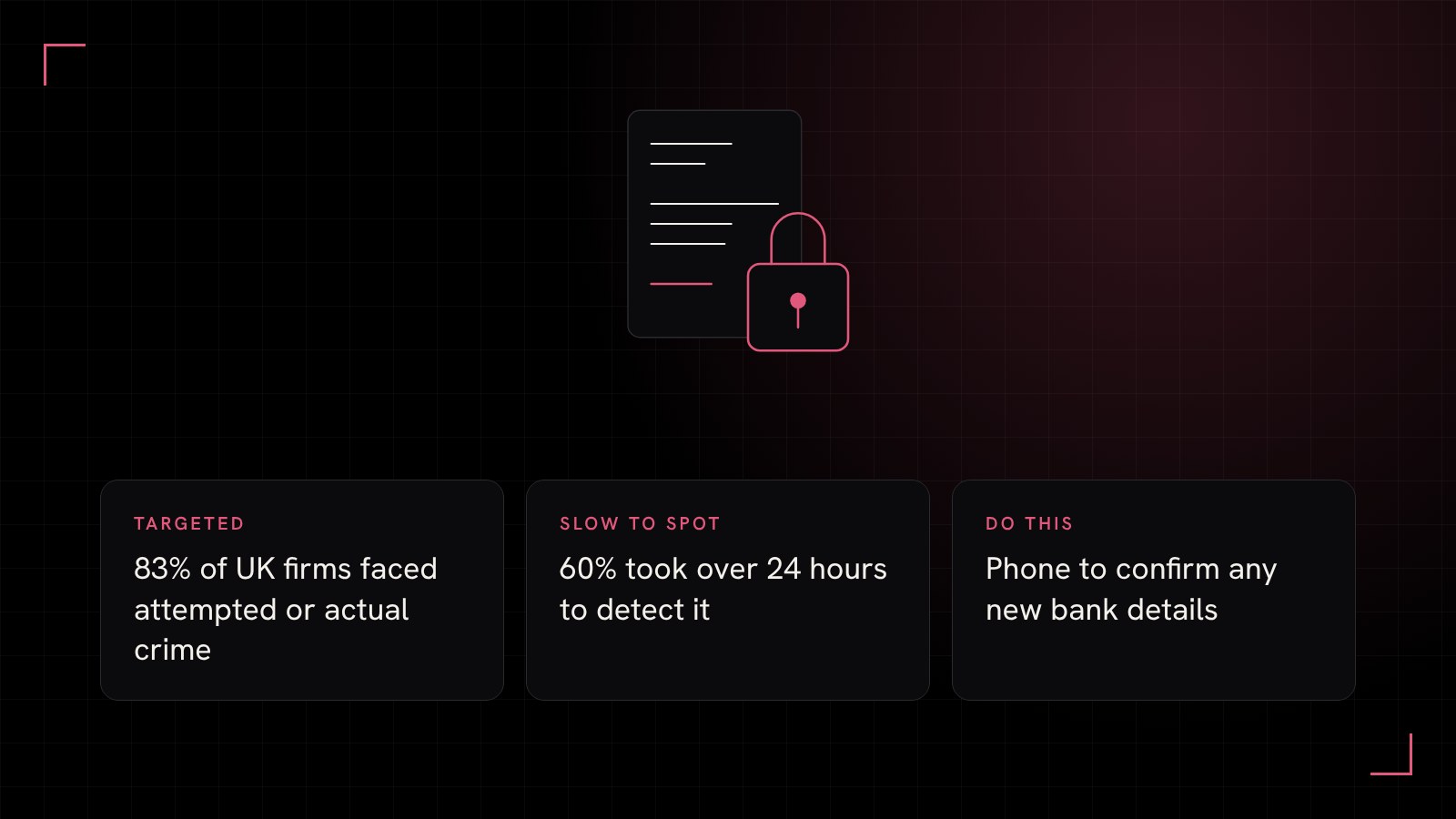
If a fraudster hasn't tried their luck with your business yet, you're in a shrinking minority. Research published by the insurance broker Gallagher on 16 November 2026 found that 83% of UK firms it surveyed faced at least one attempted or actual case of commercial crime in the past 12 months. That's well above the global figure of 75%.
UK business fraud isn't just a problem for big companies with big finance teams. The tricks in the report, such as fake invoices, supplier impersonation and staff being talked into sending money, work just as well on a five-person firm as on a large one. In this guide we look at what the figures say and the seven checks we'd suggest for UK businesses, from sole traders to larger teams.
What the research found
Here are the UK headline numbers, as reported by Insurance Business and TechRadar:
| What was measured | UK figure |
|---|---|
| Firms with an attempted or actual incident | 83% |
| Say attempts are becoming more frequent | 57% |
| Theft or dishonesty by employees | 31% |
| Scams tricking staff into handing over money or information | 26% |
| Payment fraud | 25% |
| Computer fraud | 25% |
| Took more than 24 hours to detect their latest incident | 60% |
| Took a month or more to detect it | 19% |
For businesses that lost money, the average estimated cost was £115,637 a year.
Why UK business fraud is an IT problem too
It's tempting to file fraud under "finance" and move on. But look at where most of these crimes happen: in inboxes, in accounting software, in online banking and in shared files. Almost every one of them relies on something going wrong with email, access or monitoring.
- Fake invoices and supplier impersonation usually arrive by email, often from a lookalike address or a genuine supplier mailbox that has been hacked.
- Payment fraud often follows a stolen password to online banking or accounts software.
- Insider theft goes on longest where nobody can see who changed what, and when.
- Slow detection, the figure that worried us most, is usually down to having no alerts, no logs and no one watching.
That's good news in one way: the controls that stop most of it are not expensive or complicated.
7 checks to protect your business from fraud
1. Never trust new bank details sent by email
This is the single most effective habit. If a supplier, landlord or contractor emails to say their bank details have changed, phone them on a number you already have, not one in the email. Make it a written rule that everyone follows, including the boss.
2. Use two people for payments
Set up your online banking so that one person sets up a payment and another approves it, especially for new payees or anything over a set amount. It protects against outside scams and inside dishonesty alike.
3. Turn on multi-factor authentication everywhere that matters
Email, online banking, accounting software and your Microsoft 365 admin account should all ask for a second step when signing in. A stolen password on its own is then far less useful to a criminal. We can set this up properly as part of our Microsoft 365 support.
4. Make your domain harder to impersonate
SPF, DKIM and DMARC records tell other mail servers which emails genuinely come from you, which makes spoofing your business much harder. Our free website security check shows whether yours are set up.
5. Give people only the access they need
Staff who don't handle payments shouldn't be able to see or change payee details. Remove accounts promptly when someone leaves, and review who has admin rights at least twice a year.
6. Switch on alerts so you find out in hours, not weeks
Most email, banking and accounting systems can alert you to new payees, forwarding rules, logins from unusual places and large transfers. Turn those alerts on and make sure someone reads them. Managed cyber security adds round-the-clock monitoring for the warning signs people miss.
7. Train your team to pause
Scams succeed because they create urgency: "the director needs this paid before lunch". Short, regular security awareness training teaches staff to stop, check and ask, and makes it normal to question a request even when it seems to come from the top.
What to do if you think you've been targeted
- Call your bank straight away. The sooner they know, the better the chance of stopping or recovering a payment.
- Report it to the police through the UK's national fraud and cybercrime reporting service.
- Change passwords and check mailbox rules. Criminals often add hidden forwarding rules so they can keep watching.
- Keep the evidence. Don't delete the emails or messages involved.
- Check your insurance. Insurance Business notes that many combined business policies exclude crime, so it's worth asking your broker what you're actually covered for.
How we can help
Fraud prevention works best when it's built into everyday IT rather than bolted on after a loss. With 30+ years of combined experience, we help UK businesses with:
- Managed IT helpdesk: day-to-day support including user accounts, access reviews and leavers.
- Microsoft 365: multi-factor authentication, mailbox alerts and secure settings.
- Security awareness training: phishing simulations and short, practical lessons for staff.
- Managed cyber security: 24/7 monitoring that spots suspicious activity early.
For more everyday protections, see our cyber security tips for 2026 and our summary of the NCSC Annual Review 2026. Want a second pair of eyes on your payment and email security? Get in touch and we'll talk it through.
Sources: Insurance Business: Gallagher research on UK commercial crime (17 November 2026), TechRadar: UK businesses and commercial crime (18 November 2026), Insurance Age: Gallagher research (16 November 2026), Gallagher global research release via PR Newswire (16 November 2026).