Case Study: Two-Way Radio Communications for a Large Festival Site
How we kept the teams at a large music festival near Winchester talking across more than 5 square kilometres of hilly countryside, with a repeater, secure channels and on-site support.
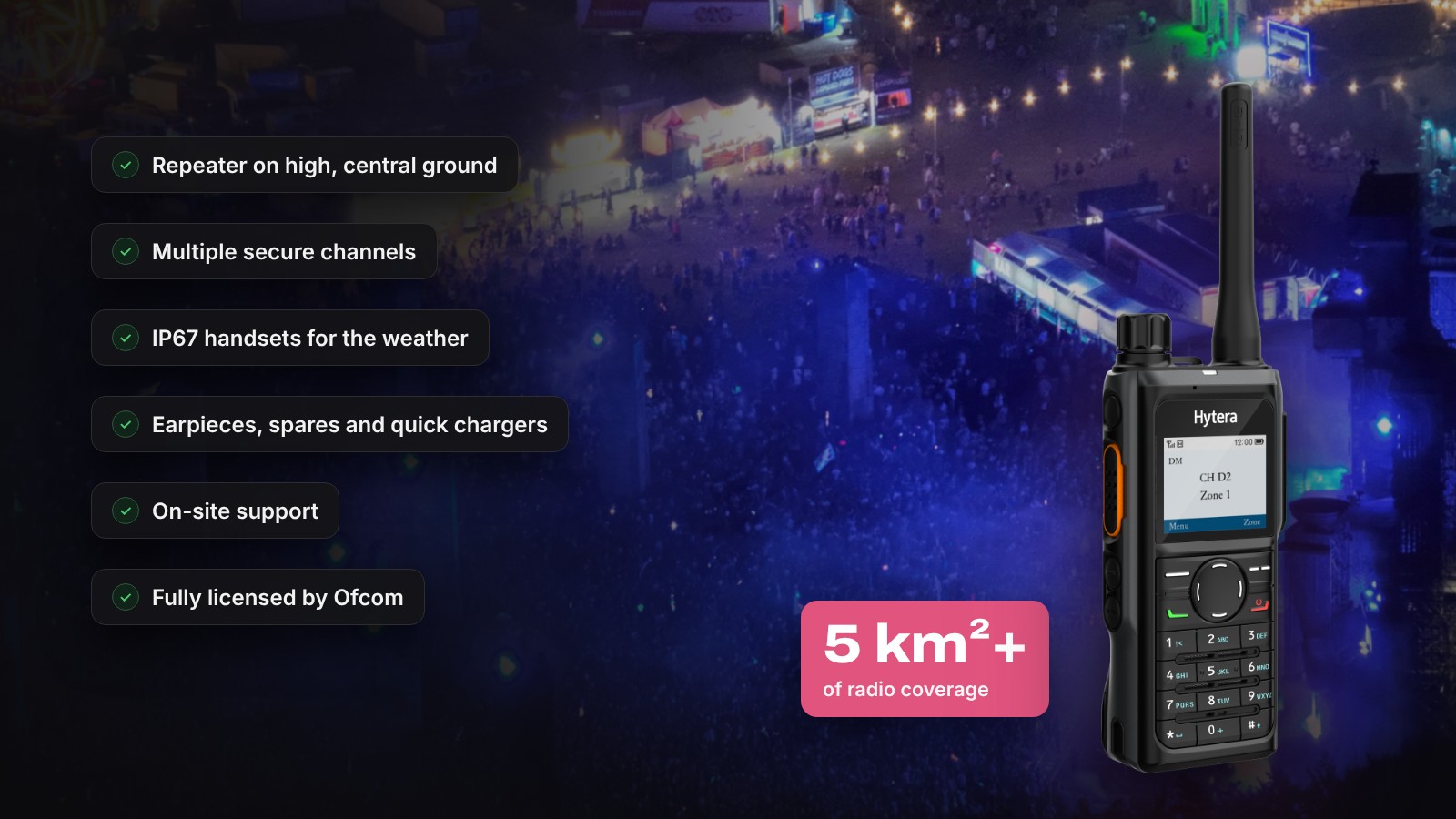
When thousands of people are on site, the teams running a festival need to be able to talk to each other instantly, wherever they are. We provided the two-way radio system for a large music festival near Winchester in Hampshire, keeping security, stewards, production, medical and site crews connected across more than 5 square kilometres of countryside.
Here's how we planned it, what we supplied and what made the difference on the day.
The challenge: a big, hilly site
Festival sites are some of the toughest places for radio communications. This one was spread across rolling Hampshire countryside, with:
- Hills and valleys between the main stage, campsites, car parks and back-of-house areas
- Woodland and tree lines separating different parts of the site
- Large structures such as stages, bars, traders' trailers and lighting towers that can block signals
- A huge crowd, with thousands of phones in a small area, so mobile networks couldn't be relied on
- Long days and nights in all weathers, from the build to the last act on stage
Handheld radios on their own would have struggled to reach from one side of a site this size to the other, especially over the hills. The organisers needed every team to hear each other clearly, wherever they were working.
Our solution
A repeater on high, central ground
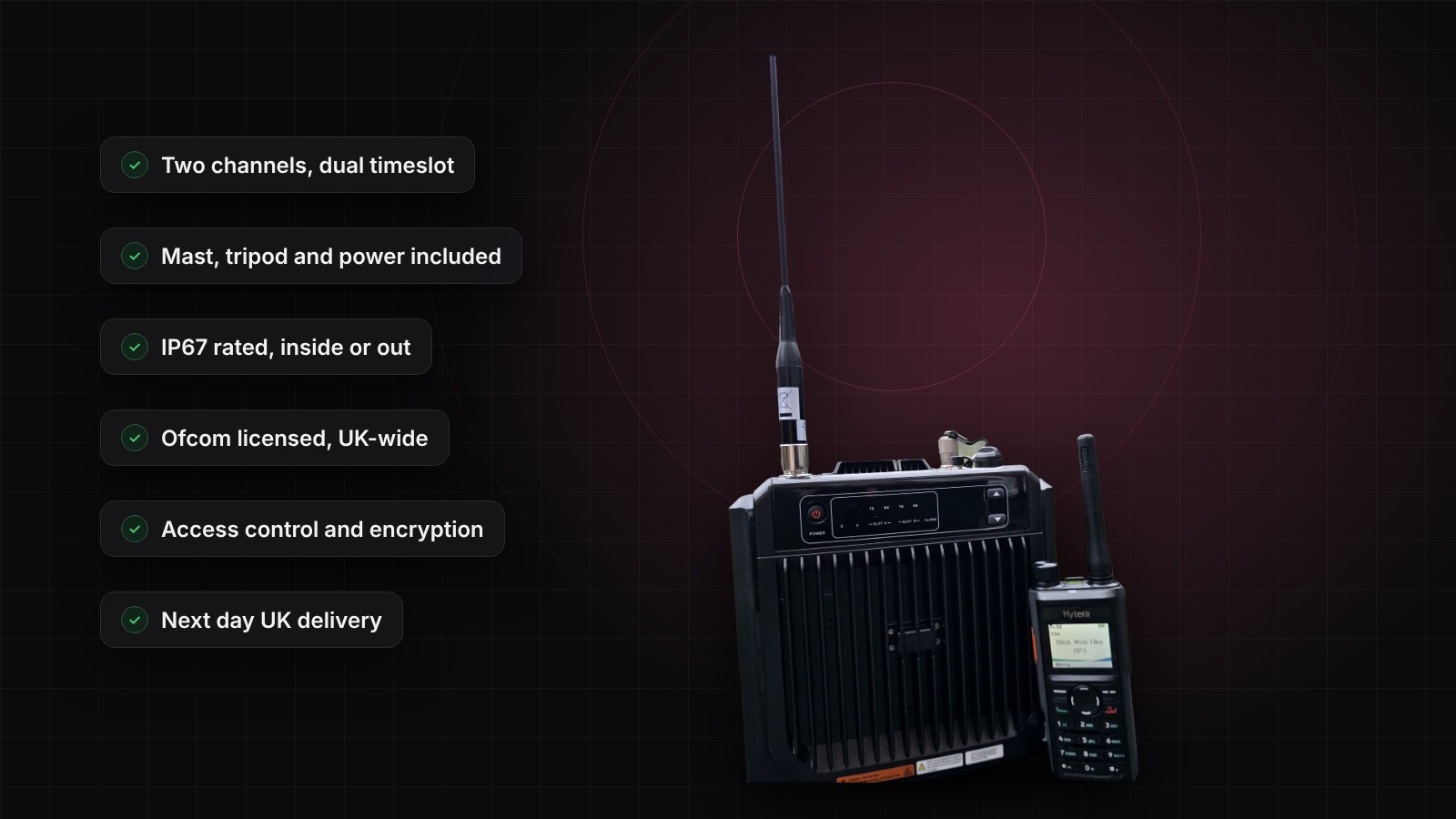
The heart of the system was a digital repeater base station, set up on a high, central point overlooking the site. A repeater picks up every radio and rebroadcasts it at higher power from a raised antenna, so each handset only needs to reach the repeater rather than the person it's talking to.
Placing it on the high ground meant it could "see" down into the valleys and across to the far campsites. The result was clear coverage across more than 5 square kilometres, from the main arena to the outer car parks. If you'd like to know more about how repeaters work, our guide to radio repeater hire explains when you need one.
Multiple channels for different teams
Different teams need different conversations. We programmed the radios with multiple channels, so groups such as security, stewards, production, site operations and medical could each talk among themselves without cluttering everyone else's airwaves. Team leaders could switch channels to reach other departments when they needed to.
Secure, private communications
At a large public event, you don't want just anyone listening in. Our digital radios use access control, so only the festival's own radios can use the system, and encryption, so conversations about security, incidents and VIP movements stayed private.
Rugged radios for English weather
British festivals mean sun one minute and a downpour the next, plus mud, dust and long shifts outdoors. We supplied IP67 rated Hytera handsets, which are sealed against dust and can cope with heavy rain and the odd drop in a puddle. They're built for working outdoors in the countryside, not just in an office.
Earpieces for noisy areas
Next to a main stage, you can't hear a radio speaker. We supplied earpieces so stewards and security could hear every message clearly over the music, and keep conversations discreet in front of the crowd.
Spare batteries and quick charging
A radio is only useful if it's charged. Every radio came with a spare battery, and we provided quick-charge options so batteries could be topped up fast between shifts. Charging was set up in a central point, so teams could swap a flat battery for a full one at shift change and get straight back to work.
On-site support
Things change quickly at a festival: a new team arrives, someone needs a radio reprogrammed, or an earpiece goes missing. We provided on-site support, so the organisers had someone on hand to sort out any issues straight away, rather than waiting for a phone call to be returned.
Fully licensed by Ofcom
Using radios and a repeater on this scale needs the right licence. Everything we supplied was covered by our own Ofcom licence, so the festival didn't need to apply for anything itself. That's the case for all our hire radios, anywhere in the UK.
Other things that helped
A few smaller details made a big difference:
- Pre-programmed and tested. Every radio and the repeater were programmed and tested before they arrived, so teams could start using them straight away.
- Clearly labelled radios, making it easy to see which team each radio belonged to and to track them in and out.
- A simple channel plan, so everyone knew which channel to use and how to reach other teams.
- Spare radios on standby, ready to hand out if a team grew or a radio was damaged.
- A quick briefing for team leaders on using the radios and good radio etiquette, so the channels stayed clear for important messages.
The result
From the build to the final night, the festival's teams had reliable, clear and private communications right across the site. Security and medical teams could respond quickly wherever they were needed, production could coordinate changeovers on stage, and stewards in the furthest campsites could get a message through first time.
Planning an event?
Whether it's a festival, a fun run, an agricultural show or a construction site, we can design a radio system that covers your whole site. We supply digital radios, repeaters, earpieces and chargers, all covered by our Ofcom licence, with next day delivery anywhere in the UK.
Take a look at our two-way radio hire, read how we supported the Theatre Royal Wakefield fun run, or see our commercial radio installs for permanent systems.
Get in touch or call us on 03303 410 910 to talk about your event.