Radio Repeater Hire: What a Repeater Does and When You Need One
Radios dropping out at the far end of your site? A repeater can make a huge difference. Here's what a repeater does, when you need one and what's included when you hire one from us.
Two-way radios are brilliant until someone at the far end of the site can't hear you. On a big event, a sprawling building site or a venue with thick walls and basements, handsets on their own can only reach so far. That's where a repeater comes in.
We now have digital repeaters in stock to hire alongside our two-way radios. Here's what a repeater does, when it's worth adding one and exactly what you get when you hire one from us.
What is a radio repeater?
A repeater is a base station that sits somewhere high or central on your site. When someone presses the button to talk, the repeater picks up their radio and instantly rebroadcasts the message at higher power, from a better position, with a bigger antenna.
Handheld radios talk directly to each other, so their range depends on the small antenna on each handset and whatever is in the way: buildings, hills, trees, steel and concrete. With a repeater, every radio only needs to reach the repeater, and the repeater does the hard work of reaching everyone else.
The benefits of using a repeater
Much greater range
This is the big one. Because the repeater transmits at higher power from a raised antenna, your team can usually talk over a far larger area than handsets alone. Exactly how far depends on the terrain and the buildings around you, but it's often the difference between "most of the site" and "all of it".
Fewer dead spots
Stairwells, basements, car parks, the back of a marquee or the far side of a building are classic black spots for handheld radios. A well-placed repeater fills in those gaps, so no one has to walk somewhere else to get a message through.
Clearer audio at the edges
Digital radios either sound clear or they don't. A repeater keeps the signal strong at the edge of your coverage, so messages stay crisp instead of breaking up.
Two channels at once
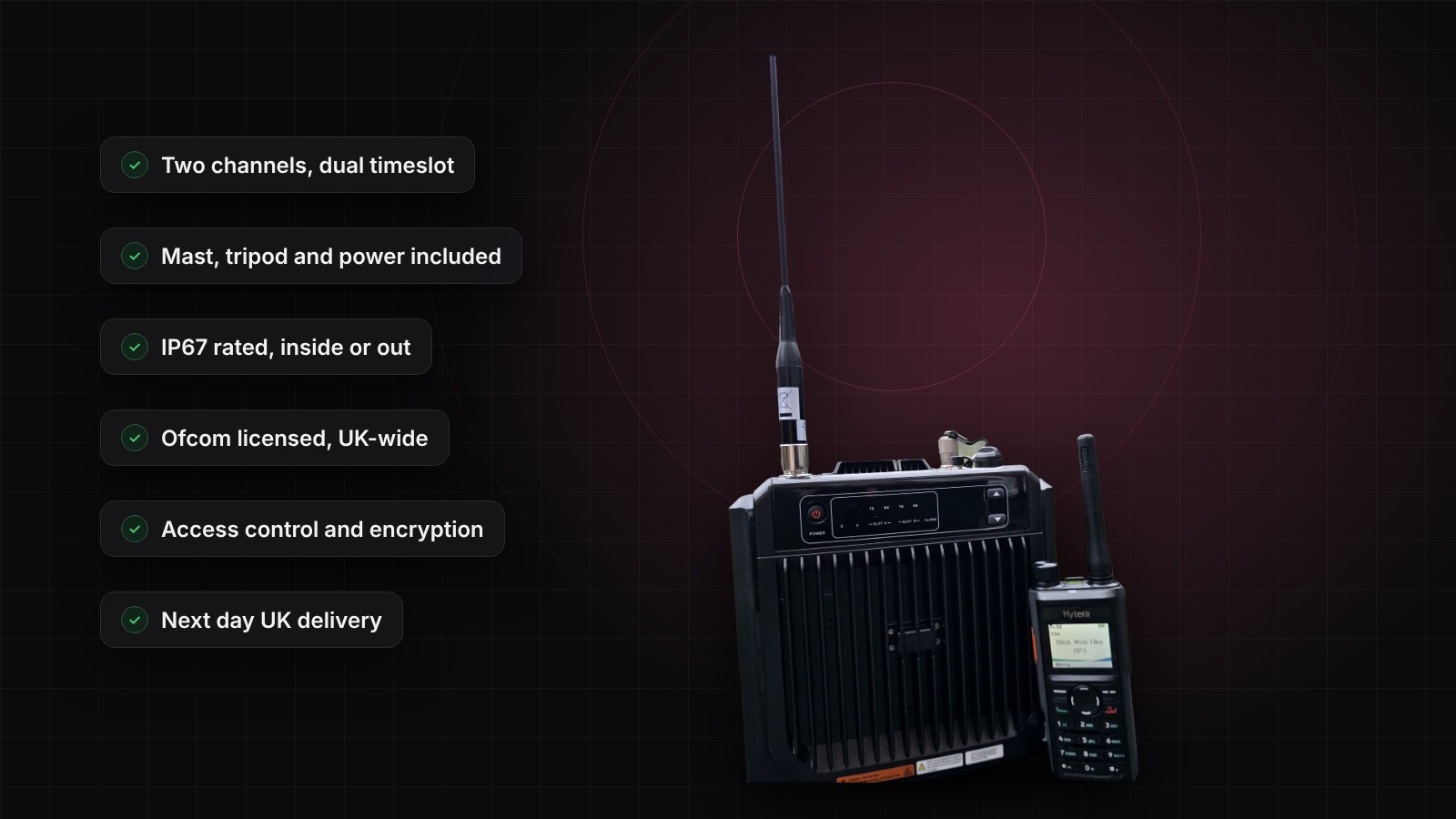
Our repeaters are digital (DMR) and use dual timeslots, which gives you two separate channels through a single repeater. For example, security and stewards can be on one channel and production or site management on the other, with neither group cluttering the other's conversations.
When might you need one?
A repeater is worth considering if:
- Your site is large or spread out, such as a festival, fun run, agricultural show, golf course, construction site or industrial estate
- You're working across several floors, or in a building with basements, plant rooms or underground car parks
- There are lots of obstacles, such as concrete, steel structures, shipping containers or hills between your teams
- Your team has had dead spots before, or people regularly say "you're breaking up"
- Different teams need their own channel without hiring two separate systems
- Safety matters, for example marshals, first aiders and security who must be able to raise the alarm from anywhere
Not sure? Tell us about your site and we'll tell you honestly whether you need a repeater or whether handsets on their own will do the job.
What's included with our repeater hire
We don't just send a box and wish you luck. Every repeater hire is a complete kit, ready to set up:
- The repeater, programmed to match your hired radios before it leaves us
- An antenna, to get the best range from the repeater
- A telescopic mast, so you can raise the antenna up high, where it works best
- A tripod, giving the mast a stable base on grass, gravel or hard standing
- A power source, so you can run it where there's no mains power nearby
- An IP67 rated unit, which means it's sealed against dust and water and happy outdoors in typical British weather
Because it's rugged and portable, you can use it inside or out: on a field, in a car park, on a scaffold, in a plant room or at the top of a stairwell.
Licensed for use anywhere in the UK
Using a radio repeater normally needs an Ofcom licence. You don't need to worry about that. Our hire radios and repeaters are covered by our own Ofcom supplier's licence, which lets you use them anywhere in the UK. There are no forms to fill in and no waiting for a licence of your own.
Digital, secure and private
Our repeaters are fully digital, which brings some useful extras:
- Access control. The repeater only works with the radios it's been programmed for, so someone with a radio from elsewhere can't use your system or jump on your channel.
- Encryption available. If your conversations are sensitive, for example security teams, VIP movements or confidential sites, we can enable encryption so no one else can listen in.
- Clear digital audio, with less background hiss than older analogue radios.
How it works on the day
- Tell us about your site and dates. We'll recommend how many radios you need and whether you need a repeater.
- We programme everything. The repeater and radios arrive set up to work together.
- Set up the repeater somewhere high or central. Extend the mast on the tripod, connect the antenna and the power and switch it on.
- Hand out the radios. Your team is ready to talk across the whole site.
We deliver next day anywhere in the UK, or you can collect free of charge from our Eastleigh or London offices. If you need a hand during your hire, our team is on the phone.
Hire a repeater from Blink Web
If your team needs more range, fewer dead spots or two channels on one system, a repeater is one of the simplest upgrades you can make. Take a look at our radio hire prices and kit, or read how we kept the Theatre Royal Wakefield fun run connected. For permanent systems, see our commercial radio installs.
Get in touch or call us on 03303 410 910 for a quote. Tell us about your site and we'll recommend the right setup.